


Thursday, September 17 2026
The revelators did not simply “expand on the Gospels” when they delivered their account of the life and teachings of Jesus in the Urantia Papers. They chose to weave the biblical tradition into the revelation by preserving whole swathes of biblical text word for word and modernizing other passages only lightly.
They added revelatory material to incidents recorded in the Gospels wherever clarification or historical correction was needed, but the great majority of Gospel passages are incorporated into the larger context of The Urantia Book with little modification.
 A clear understanding of the revelators’ extensive use of material straight out of the Bible emerges from a major new book, edited by Merritt Horn, that presents Part IV of The Urantia Book and the four New Testament Gospels synoptically—that is, side-by-side. This allows the reader to actually see how the revelators made use of the Gospels.
The reason the revelators adopted this approach was to maintain continuity with the Christian tradition and make the revelation more accessible and trustworthy to Christians, proposes Horn, who presented his book to a packed workshop at The Urantia Book Fellowship’s international conference in California last July.
Horn is a founding trustee of Urantia University Institute, former general counselor of the Fellowship, former associate trustee of Urantia Foundation, and co-chair of The Urantia Book’s Standard Reference Text committee.
His consequential study, A Harmony of the Four Gospels and the Urantia Papers (Urantia University Press), reveals with unprecedented clarity how the revelators used the Bible in constructing the narrative of Jesus’s life.
Horn explained that his project began a couple of decades ago while he was working on the Fellowship’s first edition of The Urantia Book. Something in Part IV caught his attention.
“It was a nagging problem,” he said. “I first noticed, wait a minute, this language is awfully archaic. What’s going on in The Urantia Book?”
That question led him into a long investigation of the Bible translation tradition starting with Wycliffe (1390 revision) and extending to Tyndale (1525), the Geneva Bible (1560), Douay‑Rheims (late 16th century), King James (1611), the English Revised Version (1881), and finally the American Standard Version of 1901, which was the last major revision before The Urantia Book appeared.
He discovered that the revelators worked directly from this tradition. In the workshop he demonstrated that many phrases in The Urantia Book come directly from the early translations, sometimes reaching back centuries, but that they drew mainly on the American Standard Version.
The question is, why?
“They could have chosen to tell the story of Jesus any way they wanted. They could have done their own translation. They could have started with the Greek. They could have gone back to the Aramaic. They could have done any number of things. That isn’t what they did. They used the King James tradition.”
Horn emphasized that this was a deliberate choice: “They didn’t need to use archaic language anywhere. They did it on purpose. And if the revelators made a choice, they had to have a reason.”
For Horn, this choice reveals the revelators’ respect for the living tradition of Scripture. Rather than presenting a revelation that sounds alien or disconnected, they anchored their narrative in language that resonates with centuries of Christian reading and worship.
This makes Part IV instantly recognizable and approachable to anyone formed by the Bible. When they encounter The Urantia Book’s account of Jesus, it’s not a foreign voice that they hear but a familiar one that opens into deeper clarification and expansion.
The revelators were deliberately building a bridge to Christianity and to the wider world that has been shaped by the Gospels, Horn said. He reminded the audience of the sheer scale of that world: “There’s what, 2.1 billion Christians, there’s probably another 2 billion who’ve at least heard of Jesus, probably more than that, and every one of those people’s ideas about Jesus, however scant, comes from the Gospels.”
By working within the Bible tradition, the revelators created a narrative that validates and extends the Gospels rather than replacing them. “The Urantia Book validates more of the Gospels than any other story of the historical Jesus does. There is no book that is more supportive of all the Gospels.”
He argued that this supportive stance is central to the revelators’ purpose. They were not asking Christians to abandon their Scriptures but offering a coherent, expanded portrait of the same Jesus. That portrait fills in missing context, corrects a few misattributions, and explains difficult passages, while leaving the core incidents and teachings intact.
Horn contrasted the “two‑dimensional” Jesus many readers derive from the Gospels with the three‑dimensional personality revealed in Part IV: “It’s very difficult to get anything but a two‑dimensional view of Jesus from the Gospels… The Urantia Book enables us to have a full picture, someone you can actually have a relationship with.”
But that fuller picture, he suggested, is meant to serve Christians, not supplant them. He urged Urantia Book readers to present Part IV as a historical narrative rather than a doctrinal challenge: “We don’t have to stand there and claim, ‘By the way, this comes from the fifth epochal revelation.’”
The revelators’ purpose was to give Urantia Book students a shared language with the Christian world: “You can’t talk with somebody about something they’re really into if you don’t know it too.”
Horn reminded listeners that Jesus himself trained the apostles by reading the Hebrew scriptures with them, night after night. In the same spirit, the revelators crafted a text that speaks in biblical language, so that Urantia Book readers can meet Christians where they are—inside the stories and phrases they already love.
“They created this route to Christianity, really a route to the rest of the world.”
Reframing the relationship between the Gospels and Part IV, Horn said: “Where the biblical narrative intersects with the The Urantia Book, it is no more different from the Gospels than they are from each other. Don’t think of it as something apart.”
The revelators’ purpose, he argued, was not to stand outside the Christian tradition but to stand within it, illuminating it from the inside, so that the Jesus of the Gospels and the Jesus of The Urantia Book can be recognized as one continuous, living story.

Horn identified two distinct ways the revelators used the Gospels:
As historical scaffolding, preserving incidents, sequences, and dialogue where accurate, correcting where necessary, and adding missing context; and by adopting the literary form of the King James tradition, including its rhythms, vocabulary, and phrasing, but modernized lightly to remove archaic pronouns and verb endings.
Looking at side‑by‑side passages, Horn showed that much of the text of Part IV is simply a slightly modernized American Standard Version: “Most of it’s just fixing those old verb tenses and pronouns… blessed be the Lord God of Israel, he has visited and wrought redemption… he has raised, etc. So it’s a very minor revision, but it suddenly turns it into modern English for us.”
Yet, in other places, the revelators chose to retain archaic expressions even when more contemporary wording was available. In the story of Jairus’s daughter, for example, The Urantia Book’s account preserves the phrase: “They laughed him to scorn” (152:1.1).
Horn traced this wording back beyond the 1611 King James to Tyndale (1525), and the term “damsel” all the way to a Wycliffe revision around 1390.
Similarly, in the story about the Samaritan woman at the well, the revelators retained the slightly old‑fashioned “neither come all the way hither to draw” (143:5.3), a phrasing that emerged from later Greek manuscript discoveries and was carried into the English Revised and American Standard traditions. Horn pointed out that most modern translations drop the “all the way,” but the Urantia text keeps it, again signaling continuity with the established biblical voice.
Horn also presented several examples where the revelators clarified confusing or problematic biblical passages without contradicting them.
For example, in the Bible’s story of the rich young man, Metadormus, Jesus tells him: “Go and sell all that you have...and you shall have treasure in heaven.”
Without context, this implies that to follow Jesus—to be his disciple—each of us must give up all of our possessions. But the revelators explain that Jesus was concerned about the young man’s love of riches, not riches themselves (163:2.6). Most importantly, Matadormus had to give up his possessions because he wanted to join the seventy, and only the apostles and the seventy were required to give up their possessions.
“Not knowing the background, we’re all faced with the fact that none of us can follow Jesus unless we give up everything. The Urantia Book corrects that misunderstanding.”
The biblical ending to the story of the shrewd steward (Luke 16) is famously opaque: “Make friends for yourselves by means of the mammon of unrighteousness… that they may receive you into the eternal habitations.”
Horn called this “one of those ‘What?’ passages.” But the revelators clarify the meaning: “Conduct your lives that you make eternal friendship with the forces of righteousness… that when all things earthly fail you shall be joyfully received into the heavenly habitations” (169:2.5).
“Now it makes perfect sense,” Horn noted.
Again, in the story of the unjust judge, the Bible implies that persistence in prayer may “wear down” God.
The revelators clarify: “Your persistence, however, is not to win favor with God but to change your earth attitude and to enlarge your soul’s capacity for spirit receptivity” (144:2.5).
Horn said: “Again, the story is identical, but the conclusion now makes sense.”
In one of the most striking Biblical anomalies, Jesus appears to call the Syro‑Phoenician woman a “dog.”
In The Urantia Book, the remark is correctly attributed to Simon Zelotes, whose temperament fits the statement (156:1.5).
Horn explained: “In the Bible you’re left with: does Jesus really mean that? The Urantia Book says: this is a misattributed quote. And that fixes the whole thing.”
Horn urged readers to recognize that the revelators did not dismiss the biblical record but honored it, preserved it, and clarified it.
He emphasized that Urantia Book readers must learn the Bible if they hope to communicate effectively with Christians: “You can’t talk with somebody about something they’re really into if you don’t know it too. The revelators have shown us how to speak with people in their language.”
The Harmony is designed to serve not just as a reference book but as a reading edition of Part IV, allowing readers to see—visually and directly—how the revelators used biblical text.
“This gives us a way to be successful from the start,” he said. “Instead of being worn down by disappointment.”
Horn’s work is intended to reveal that Part IV is not a replacement for the Gospels, but a continuation and clarification of the story Christians have cherished for two thousand years. It enables readers to see clearly how the revelators built a bridge to a more complete portrait of Jesus of Nazareth and a fuller account of his life.
A Harmony of the Four Gospels and the Urantia Papers is available from Urantia University Press.
Merritt Horn will be teaching a UUI course this fall on the relationship between The Urantia Book and the Gospels.
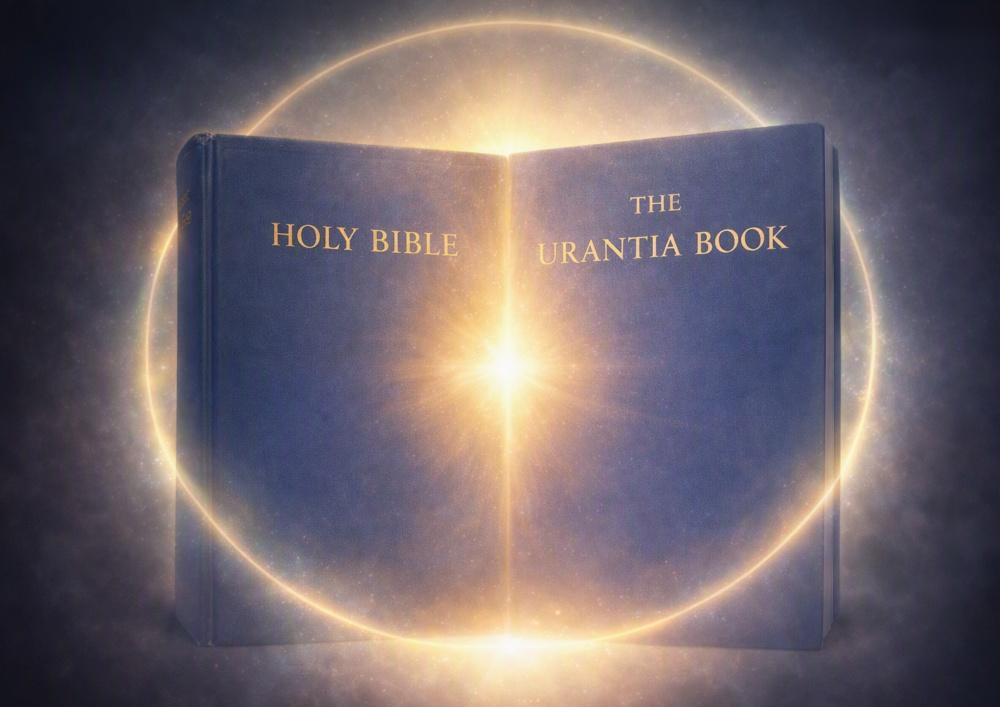
Top image generated by AI for the Fellowship website.


Comments
By posting, you agree to follow our Community Standards.