


Thursday, April 09 2026
There is a gene in your body that science cannot explain.
It is called MCPH1 haplogroup D. It regulates brain size during fetal development. It appeared approximately 37,000 years ago and spread to roughly 70% of all humanity under a pressure of positive selection so strong that the mathematics of neutral genetic drift cannot account for it. The science team that discovered it—Evans, Mekel-Bobrov, and Lahn, publishing in Science in 2005 and PNAS in 2006—confirmed the selection was real and admitted they had no explanation for the selective advantage. A follow-up study showed the variant did not originate within the modern human evolutionary line at all. It came from a lineage isolated from Homo sapiens for approximately 1.1 million years. A Neanderthal tested for it came back negative. The source is, in the mainstream scientific literature, unknown.
The Urantia Book tells us who they were.
The book places the arrival of Adam and Eve—Material Sons and Daughters carrying the violet life plasm—at approximately 37,841 BCE. That is within the error margin of the Evans team’s genomic dating. It places their genetic endowment, by design, outside the evolutionary human line entirely: engineered by Life Carriers, introduced by deliberate admixture, carrying a biological enhancement whose full mechanism exceeds what single-locus genomic analysis can capture. Haplogroup D is not proof of the Adam and Eve arrival. But it is a 37,000-year-old genomic anomaly of unknown archaic origin that is distributed across humanity in exactly the geographic pattern The Urantia Book describes for the Adamic and Andite dispersal — and it deserves to be on our radar.
This article is about the Andites—who they were, what they built, and what they left behind. The haplogroup D data is the newest piece of a picture that has been assembling itself for decades in the archaeological and genetic record, one anomaly at a time. Once you learn to read it, you cannot unsee them.

The Andite Migration Map — corridors from the Mesopotamian origin zone across six continents, ~25,000 BCE to ~2,750 BCE. The Madagascar Limit (red dashed line) marks the precise boundary 78:5.5 predicts. Based on Urantia Book Papers 78–79.
The Andites were not a naturally evolved ethnic group. They were a biological synthesis—a triple convergence of three distinct human streams—forged over tens of thousands of years in the Mesopotamian basin and the highland zones surrounding it.
The first stream was the Nodite base: the descendants of the rebellious sixty members of Caligastia’s staff who severed their connection to the Tree of Life after the Lucifer Rebellion and began reproducing with the surrounding evolutionary peoples. These were beings of exceptional physical endowment, carrying the institutional memory of 300,000 years of Dalamatian administrative tradition: the ten councils whose curriculum encoded hydraulic engineering, metallurgy, astronomy, agriculture, and the rudiments of moral philosophy into hereditary guild knowledge. These are the Nephilim of Genesis, the Titans of Greek mythology, the Anunnaki in their rebellious aspect. Not mythological creatures. A real population with a real genealogy.
The second stream was the Adamic Violet Race: the biological endowment introduced by Adam and Eve, whose violet life plasm produced the blue-eyed, fair-complexioned phenotype The Urantia Book describes and the OCA2 gene mutation science dates to the same 35,000–40,000 BCE window as the Adamic arrival. This is where haplogroup D enters the picture as well. Two independent genetic markers. One arrival window. The Urantia Book described the arrival first.
The third stream was the Andonite foundation: the original evolutionary humans of this world, whose biological robustness grounded the more rarefied Adamic and Nodite endowments in the resilience necessary for planetary-scale survival across tens of thousands of years of migration.
The crystallization of these three streams into a self-replicating race happened at a specific place with specific people. Adamson—the first-born of the violet race of Urantia (77:5.1)—established an independent center in the Kopet Dag highlands northeast of Mesopotamia. His partner Ratta, the last of an unbroken Nodite-Amadonite lineage (77:5.8), brought the third stream into the synthesis. Their sixteen children founded the two family lines: the Sato intellectual line that eventually seeded Greece with 375 selected superior people (80:7.3–7.4), and the Thor physical line that pushed northward into Scandinavia and gave rise to the Aesir tradition. The genetic event happened. The mythology that followed it preserved the memory.
“The Andites were the best all-round human stock to appear on Urantia since the days of the pure-line violet peoples.” 78:4.3

The Andite Triple Synthesis — from Caligastia's staff and the Nodite rebellion through the Adamic arrival and Kopet Dag crystallization to the two primary dispersal lines. Based on Papers 66, 73–77.
Of everything the Andites carried into the ancient world, the most archaeologically identifiable is not genetic. It is hydraulic.
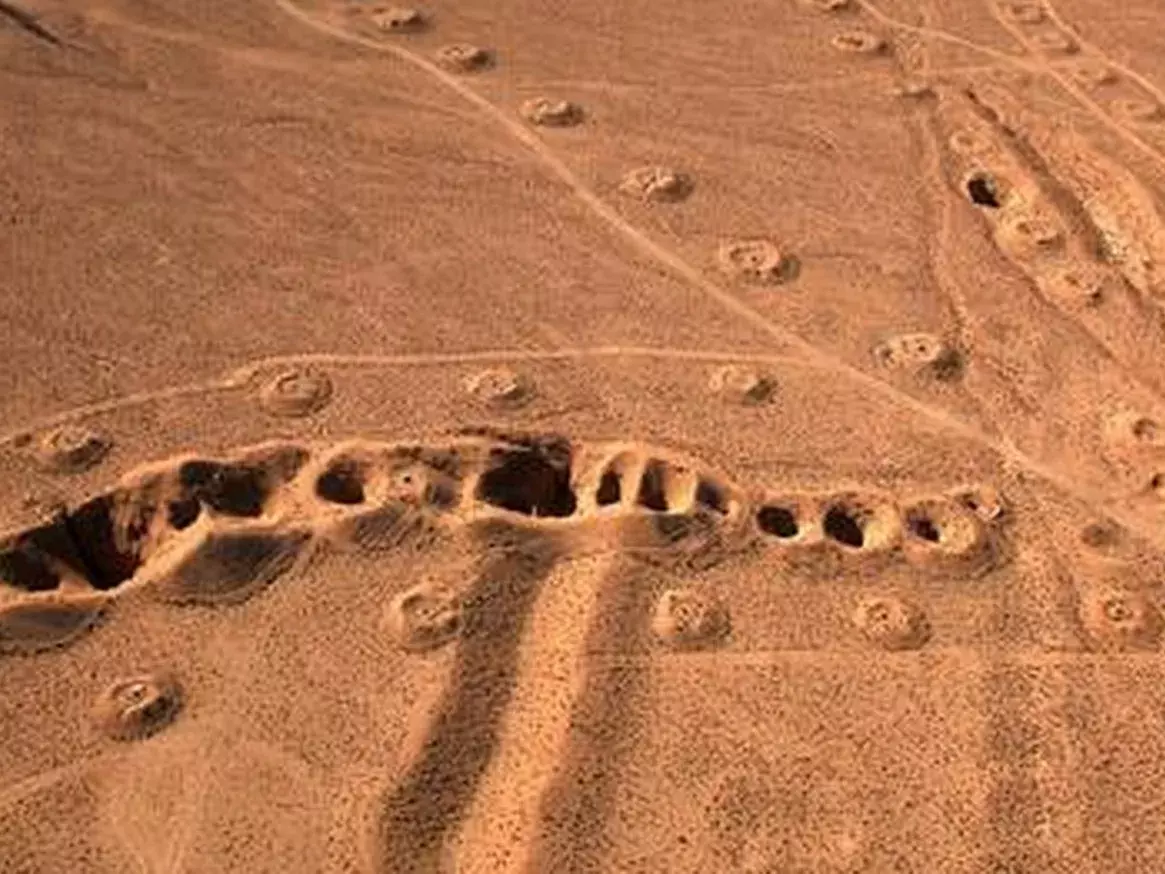
The Urantia Book traces this directly to Ang, the head of the Council on Food and Material Welfare at Dalamatia, who “taught well-digging, spring control, and irrigation” (66:5.2). That council operated for approximately 300,000 years before the Lucifer Rebellion encoded its principles into the hereditary knowledge of the Nodite descendants. When the Adamic Default exiled the Adamite line from the prepared surface abundance of the First Garden into the unprepared soil of the Tigris-Euphrates floodplain, and then into progressively more arid zones as the Andite diaspora unfolded, the engineering response was the qanat: a gently sloping underground tunnel tapping a high-altitude aquifer at an uphill mother well and conveying water entirely by gravity to a downhill outlet. No pump. No power. Just the physics of gradient and gravity, maintained across miles of subterranean gallery.
In Persia it is called the qanat. In Afghanistan, the karez. In Morocco, the khettara. In Algeria, the foggara. In Spain, the viajes de agua. In Japan, the mambo. In Peru and Chile, the puquios. Every single one of these systems operates on the identical engineering principle. The mainstream explanation is convergent invention. That explanation requires cultures in Iran, Morocco, Japan, and Peru to have independently derived the same highly specific solution without contact—and requires the coincidence that this same tall, dolichocephalic, large-eyed population signature appears in burial and artistic records near every major instance of the tradition. The Andite dispersal hypothesis requires none of that to be coincidence.
|
Tradition |
Region |
Local Date |
UB Corridor |
|
Qanat |
Iran / Central Asia |
3,000+ BCE |
Heartland Origin |
|
Karez |
Afghanistan / Xinjiang |
c. 2,000 BCE+ |
Eastward Surge |
|
Khettara |
Morocco / Sahara |
c. 2,000–1,000 BCE |
Saharan Push |
|
Viajes de Agua |
Spain / Iberia |
Pre-Roman |
Western Wave |
|
Puquio |
Peru / Chile |
c. 500 BCE–500 CE |
Andite 132 Fleet |
|
Mambo |
Japan |
Pre-1,000 CE |
Eastward Surge terminal |
One engineering principle, six continents, along the Andite migration corridors.

Qanat cross-section — the Andite hydraulic inheritance. Ang's Council curriculum (66:5.2), 300,000 years of institutional refinement, distributed across six continents.
The most concentrated forensic case sits in the Tarim Basin in western China, where perfectly preserved Caucasian mummies—tall, red-haired, dolichocephalic, buried in woven tartan with no local developmental precedent—lie in the same region as the Karez water system that operates on the identical principle as the Iranian qanats predating it by thousands of years. A specific people carried a specific technology to a specific place. Both the genetic and hydraulic record confirm it.
The global megalithic tradition has a distribution problem that conventional archaeology has never satisfactorily solved. When you sort the major sites not by culture but by construction date and geography, they do not scatter randomly. They describe a directional expansion radiating outward from a single origin zone in the Anatolian and Mesopotamian heartland, with later dates as distance from the origin point increases.
Göbekli Tepe and Karahan Tepe in southeastern Turkey date to approximately 9,500 BCE. No residential occupation has been found at either site. They are not villages. They are the T-pillar geometric alignment curriculum of the Nodite mason guilds at maximum concentration, before the diaspora began distributing that knowledge globally. Moving outward and forward in time: the Tower of Jericho at 8,000 BCE; Nabta Playa (Egypt) at 7,000 BCE; Carnac (France) at 4,500 BCE; Newgrange (Ireland) at 3,200 BCE; Stonehenge beginning at 3,000 BCE.
And then Callacpuma in the Andean highlands of northern Peru, where concentric circular megalith construction begins around 2,750 BCE — with no intermediate development, no local precursor, no regional sequence leading up to it. At the same moment, Stonehenge is building concentric circles in England, 12,000 kilometers away, using the same geometric organizing principle. The Urantia Book records that 132 Andite navigators embarked from Japan in a fleet of small boats and reached South America (78:5.7). The timing of their arrival fits the 2,750 BCE window. Callacpuma is the architectural signature of Andite navigators deploying, within their first generation of South American settlement, the geometric blueprint their people had been building with for seven thousand years.
“One hundred and thirty-two of this race, embarking in a fleet of small boats from Japan, eventually reached South America and by intermarriage with the natives of the Andes established the ancestry of the later rulers of the Incas.” 78:5.7

The Megalithic Blast Radius—construction dates mapped chronologically from the Anatolian origin at 9,500 BCE outward to Callacpuma at 2,750 BCE. A walking-and-sailing distribution pattern. No spacecraft required.
One of the most powerful confirmations in the entire record is not where the Andites appeared. It is where they did not.
The Urantia Book is precise: “Only a few teachers and traders ever penetrated farther south in Africa than the headwaters of the Nile” (78:5.5). That is a falsifiable claim. The arid conditions that drove qanat engineering in Iran, Morocco, and the Andes also exist in sub-Saharan Africa, the Kalahari, the Namib, the Horn, and the highlands of Madagascar. If the hydraulic tradition spread by independent invention wherever arid conditions motivated it, we would expect to find it in all of those places. We do not. The qanat tradition, the megalithic precision tradition, and the large-eyed phenotypic iconography all stop below the Nile headwaters. Madagascar has none of it.
When the boundary a historical source predicts matches the boundary the physical record shows—not approximately, with exceptions, but precisely—that is confirmation. The Madagascar Limit is the clearest single piece of negative evidence for the accuracy of The Urantia Book’s Andite migration account. It makes a specific, geographically falsifiable prediction. The record confirms it.
|
MCPH1 Haplogroup D — What the Science Actually Shows Evans et al. (Science, 2005; PNAS, 2006) documented a derived variant at the MCPH1 locus — haplogroup D — with the following properties: • Coalescence age: approximately 37,000 years before present (range 14,000–62,000; mean ~37,000). • Worldwide frequency: ~70% of all humans sampled globally. • Speed of spread: mathematically incompatible with neutral drift. Consistent only with strong positive selection. • Geographic distribution: dominant in Eurasian, Central Asian, South Asian, and East Asian populations. Markedly absent in Sub-Saharan Africa. • Origin: not within the modern human evolutionary line. Came from a lineage separated from Homo sapiens for approximately 1.1 million years, entering the gene pool by admixture circa 37,000 years ago. • Neanderthal result: Lari et al. (2010) tested a Neanderthal fossil at the MCPH1 locus. It was homozygous for the ancestral non-D allele. The source of haplogroup D remains, in the mainstream literature, unknown. • Selective advantage: also unknown. Science identified strong selection but could not identify the mechanism. The Urantia Book provides the candidate explanation for all of the above: a Life Carrier-engineered genome, introduced into the ascending mortal line by deliberate admixture circa 37,841 BCE, carrying a cognitive and spiritual enhancement whose full mechanism exceeds the resolution of single-locus genomic analysis. |

MCPH1 Haplogroup D geographic density overlay mapped against Andite dispersal corridors. High density (gold) tracks UB Papers 78–79 migration routes. Marked absence in Sub-Saharan Africa confirms the Madagascar Limit. Evans et al. 2005, 2006.
By approximately 1,500 BCE, the pure Andite genetic line had been fully absorbed into the surrounding populations. The Urantia Book records that the biological legacy was distributed into every race it touched, with Andite blood estimated at between one percent in some peoples and fifty percent in the European populations (80:9.9).
The haplogroup D distribution map, produced by genomic analysis of modern populations, with no reference to The Urantia Book, describes this exact geographic pattern. By 12,000 BCE, the book records that three quarters of Andite stock was resident in northern and eastern Europe (78:5.4). The final waves sent 65% into Europe and the remainder into India, Central Asia, and East Asia via the corridors described in Paper 79. The haplogroup D footprint tracks those corridors. It is absent from sub-Saharan Africa. It stops at the Madagascar Limit.
The Urantia Book described the migration first. The genomic data confirmed the footprint independently, decades later. That is not nothing.
The full scope of the Andite story is not only material, and this is the part that matters most to us as Urantia Book readers. The hydraulic engineering, the megalithic construction, the metallurgy, the genetic dispersal…these were not ends in themselves. They were operating in service of a single planetary purpose: the biological and cultural preparation of the human races of this world for the epochal revelations, and ultimately for the personal bestowal of the Creator Son.
The Dalamatian administration operated for approximately 300,000 years under the explicit directive of bringing the evolutionary races toward receptivity. Hap’s seven commands—the ethical curriculum of the Dalamatian Council of Revelation and Religion—are the direct precursor of the Melchizedek commandments and through them the Mosaic ten (66:7.8). The transmission chain from 500,000 BCE to the present runs through specific, traceable institutional links. It did not break. It compressed, mythologized, and nearly went underground—but it did not break.
The Adamic Default was the hinge. Eve was deceived, not rebellious. Adam was fully aware of what he was doing and chose it anyway out of what The Urantia Book calls “supermortal love” (75:5.1); he was unwilling to live the remainder of his mortal existence without his partner. The biological consequence was immediate: degradation from Material Son status to mortal. Adam lived 530 more years and died of old age (76:5.5). But before he died, the engineering imperative had already begun. The default of Eden is the origin story of the qanat. Every subterranean water system on six continents is, at its deepest level, a civilizational response to the loss of the First Garden.
When Machiventa Melchizedek materialized at Salem 1,973 years before the birth of Jesus (93:2.1), the pure Andite line was already in terminal dispersal. The institutional knowledge was becoming ritual, then myth, then legend. The concept of the Universal Father—the core theological inheritance of the entire program—was on the verge of disappearing from human consciousness. Melchizedek’s emergency materialization was the universe hierarchy’s response: keep the faith-covenant concept alive. God agrees to do everything; man only agrees to believe. Not a new idea. Hap’s curriculum, reformulated after 498,000 years of transmission, had nearly extinguished it.
The qanat is not just a water delivery system. The megalithic circle is not just an architectural preference. The Smith Guilds are not just technical institutions. They are all expressions of the same drive: a superhuman-derived population attempting to stabilize and elevate a world severed from its normal developmental support systems by the Lucifer Rebellion, working with whatever biological, institutional, and material tools they had available across a span of time that makes all of recorded history look like a footnote.
“The culture of Mesopotamia quietly spread out over Europe, India, China, northern Africa, and the Pacific Islands.” (78:5.3)
The Andite line is gone. By 1,500 BCE the pure genetics had diluted into the general population. By the time Melchizedek arrived at Salem, the civilization had been in terminal dispersal for millennia. The guild knowledge had become ritual. The ritual had become myth. The myth had nearly become silence.
But the infrastructure is still here. The qanat at Gonabad in Iran, constructed thousands of years ago, still flows today, still delivering water by gravity from the mountain aquifer to the village outlet on the exact engineering principle that Ang’s council developed in Dalamatia half a million years ago. The Triple Spiral at Newgrange still catches the winter solstice sun every December 21st, encoding two memories simultaneously: the concentric paradise that was lost and the subterranean water that was found to replace it. The Moai of Easter Island still face back across the ocean their ancestors crossed, carving the faces of their people in volcanic tuff so the record would survive them.
And in the genomic record, a brain-size regulatory gene that swept through 70% of humanity 37,000 years ago, that originated from a lineage science cannot place in the known human evolutionary tree, is distributed across exactly the geographic corridors The Urantia Book identifies as the Andite migration routes—absent from exactly the regions the book says the Andites did not reach. The selective advantage is unknown. The archaic origin is unknown. Science is pointing at a mystery it cannot solve with the framework it currently has.
We have the framework. The book described the mechanism. The genomic data confirmed the footprint. The hydraulic record confirmed the engineering tradition. The megalithic record confirmed the timeline. The Madagascar Limit confirmed the boundary. The Tarim Basin mummies confirmed the phenotype.
We do not study the Andites as ancient history. We live in the civilization they designed. The standardized brick, the alphabetic writing system, the urban sanitation grid, the agricultural calendar, the ethical transmission of the universal fatherhood of God—all of it traces back through the migration corridors of the Andite dispersal to the Ten Councils of Dalamatia, operating in the Persian Gulf basin half a million years ago, under a planetary program that was trying to do something remarkable: uplift an entire world.
It worked. Imperfectly, through a rebellion that shattered the plan and a default that exiled the uplifters from their prepared paradise into unprepared soil, through systematic dilution of the finest genetic endowment this planet has carried into the general evolutionary population. It worked through all of that. The faith-covenant concept survived. The hydraulic infrastructure sustained civilizations. The guild knowledge built the cities. The prophet chain reached the Universal Father. The Creator Son came.
We are the evidence that the program worked. And we are only now, in the early centuries of the fifth epochal revelation, beginning to read the record correctly.
Top photo: Aerial view of Persian qanat shaft lines (UNESCO World Heritage Site). Each circular depression marks a vertical maintenance shaft descending to the underground gallery. Multiple qanat lines run in parallel, forming an engineered water distribution grid across otherwise uninhabitable desert. This infrastructure stops precisely where The Urantia Book's Andite migration perimeter predicts.
The Urantia Book. Urantia Foundation, Chicago, 1955. Papers 66, 73, 74, 75, 76, 77, 78, 79, 80, 93.
Evans, P.D., et al. (2005). Microcephalin, a gene regulating brain size, continues to evolve adaptively in humans. Science, 309(5741), 1717–1720.
Evans, P.D., et al. (2006). Evidence that the adaptive allele of the brain size gene microcephalin introgressed into Homo sapiens from an archaic Homo lineage. PNAS, 103(48), 18178–18183.
Lari, M., et al. (2010). The Microcephalin Ancestral Allele in a Neanderthal Individual. PLOS One, PMC2871044.
Eiberg, H., et al. (2008). Blue eye color in humans may be caused by a perfectly associated founder mutation in a regulatory element within HERC2 inhibiting OCA2 expression. Human Genetics, 123(2), 177–187.
Mallory, J.P., and Mair, V.H. (2000). The Tarim Mummies. Thames and Hudson.
Schmidt, K. (2006). Sie bauten die ersten Tempel. C.H. Beck.
Wulff, H.E. (1968). The Qanats of Iran. Scientific American, 218(4), 94–105.
|
About the Author Derek Samaras is a videographer, content creator, and independent researcher based in Gunbarrel, Colorado. He hosts and produces the Urantia Book Network YouTube channel, including the Spirit of Truth interview series and the Sermons of Jesus cinematic production. He is the lead developer of DALAMATIA: The Planetary Rebellion, a narrative action-RPG based on Urantia Book lore. This article is drawn from the Andite Civilization Master Notebook, a multi-volume production bible synthesizing Urantia Book canonical history with the global archaeological and genetic record. See more at: urantiabooknetwork.com |


Comments
By posting, you agree to follow our Community Standards.